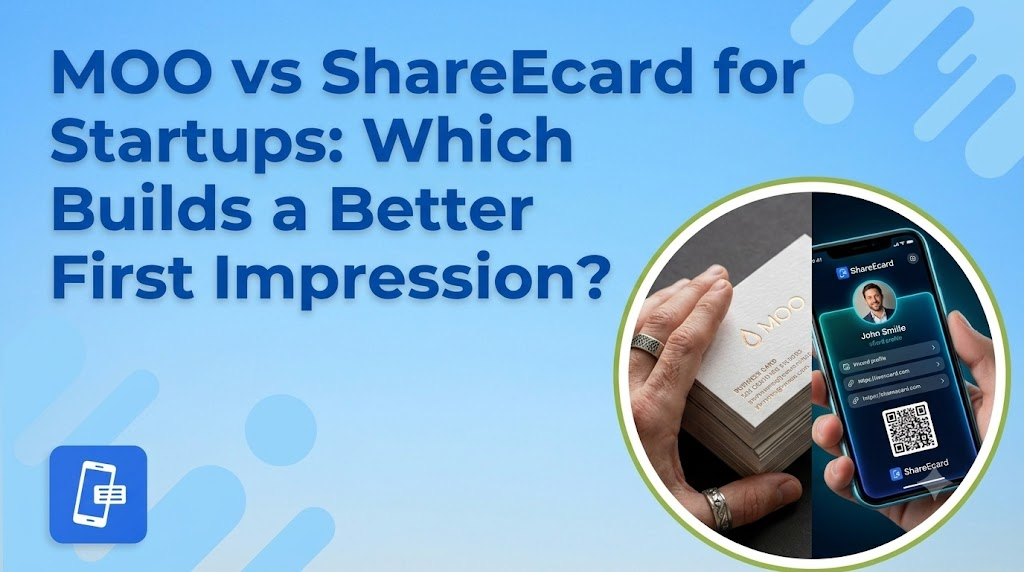
MOO vs ShareEcard for Startups: Which Builds a Better First Impression?
A startup’s first impression usually happens in a room where the stakes are disproportionate to the moment, an investor pitch, a cofounder intro, a first enterprise client meeting. What you hand someone in that room matters, but so does what happens to your details six weeks later when your title changes, your company pivots, or you close a round and update your deck’s branding. The best business card for startups has to survive that pace, not just look good on day one.
Startups Pivot. Printed Cards Don’t.
Early-stage companies change more than almost any other business type: titles shift as founders take on new roles, company names get refined after a rebrand, taglines get rewritten after user feedback, and entire product directions sometimes change after a failed launch. A batch of MOO cards, however well designed, freezes all of that at the moment of printing. Order 100 cards before a pivot and you’re either handing out inaccurate information or absorbing the cost of a second print run before the first batch is gone.
This is the specific problem a digital business card for startups solves that no amount of paper quality fixes. A ShareEcard link updates the instant your title, deck, or company details change, and everyone who already has your QR code sees the current version automatically, no reprint, no awkward correction at the next meeting.
The Real Cost Math for a Pre-Revenue Team
MOO’s pricing starts around a 50-card minimum and climbs from there depending on stock and finish, and it’s rarely the cheapest print option available. For a founder watching runway closely, that’s not a rounding error, it’s cash that could go toward payroll, infrastructure, or the next sprint. ShareEcard’s core card, QR code, and sharing tools are free indefinitely, with a one-time $9.99 fee only if you want to upload a fully custom branded design instead of a template. For a two-person founding team deciding between a print order and free software, the math isn’t close.
This matters even more once you’re hiring. A startup that goes from three people to twelve in a single quarter needs cards, or the digital equivalent, for every new hire immediately, not after the next print run clears MOO’s fulfillment queue. ShareEcard’s enterprise team management creates and updates cards for new hires from one dashboard the same day they join, which is closer to how startups actually grow than a quarterly reorder cycle.
First Impressions Are About the Moment, Not the Material
There’s a lingering assumption that a heavier, more tactile printed card signals more credibility than a QR code. That assumption is aging out fast. Founders and investors increasingly read a slick, instantly shareable digital card as a signal that a company is comfortable with modern tools, which is exactly the impression an early-stage tech company usually wants to make. A QR code that opens a clean, branded profile with a working LinkedIn link, a pitch deck link, and a working email in one tap does more work in that first ten seconds than a nicely printed card that still requires someone to manually type your email into their phone later, if they remember to at all.
As one of the more effective first impression networking tools, a digital card also solves a problem printed cards create by design, it removes the moment where someone has to decide whether your card is worth keeping instead of getting lost in a jacket pocket after a conference.
Affordable Branding That Actually Matches Your Stage
Every dollar spent on a startup’s early branding should be visible in the product or the pitch, not sunk into reordering print runs. Affordable branding for new business at the pre-seed or seed stage usually means picking tools that scale with the company rather than requiring a new purchase decision every time something changes. ShareEcard’s free template library gets a founding team a professional-looking card immediately, and its Link in Bio feature doubles as a lightweight landing page for social and portfolio links without needing a separate website built before there’s traction to justify one.
Where MOO Still Has a Place for an Early-Stage Company
If your startup is consumer-facing and building a physical retail or event presence, a Chicago pop-up, a trade show booth, a product sampling table, a printed card with real paper weight can reinforce a tactile brand experience that a QR code alone doesn’t deliver. That’s a legitimate case for MOO, particularly once a startup has stabilized its branding enough that a print run won’t be outdated in a month. It’s a later-stage decision for most startups, not a day-one one.
The Bottom Line
For the earliest, fastest-changing phase of a company’s life, the best business card for startups is the one that doesn’t need reordering every time the company changes, which at this stage is often. A digital card keeps pace with pivots, hiring sprints, and rebrands at zero incremental cost, while a printed batch locks in a version of your company that may not exist by the time the second box arrives.
Frequently Asked Questions
Do investors actually care whether a founder hands them a digital or printed card? Most investors care more about how quickly and cleanly they can get your contact details and materials than the card’s physical format, and a digital card that opens a working deck link and email in one scan tends to leave a stronger practical impression than a paper card they have to manually enter later.
How fast can a startup update its cards after a pivot or rebrand with ShareEcard? Changes take effect immediately. There’s no reprint or reorder step, since the card content updates on the same link and QR code everyone already has.
Is it worth ordering printed MOO cards before a startup has finalized its branding? Generally not. Any print run locks in a name, tagline, or title that pre-seed and seed-stage companies frequently change, so it’s usually more capital-efficient to wait until branding has stabilized before committing to a physical order.
Can a growing startup add cards for new hires quickly without reordering? Yes, with a digital platform like ShareEcard, new hires get a card created and added to the team dashboard the same day, compared to waiting on a new print batch to accommodate headcount growth.