Keith Sapsford: The Tragic Story Behind the Famous Airport Photograph
Keith Sapsford is a name that continues to surface in aviation discussions, photography circles, and cautionary real-world safety stories. His story is often remembered not because of fame or achievement, but because of a tragic accident that became permanently preserved in one of the most haunting photographs ever captured. Below is a detailed, expert-style exploration of his life, the circumstances surrounding the incident, and the broader implications it left behind.
Early Life and Background of Keith Sapsford
Keith Sapsford was a young Australian boy who grew up in a relatively ordinary environment, but like many teenagers, he was curious about the world beyond his immediate surroundings. Accounts of his early life describe him as adventurous and restless, with a strong desire to travel and experience life outside of Australia. This curiosity, while not unusual for his age, played a major role in the path his life eventually took.
He was raised in a time when international travel was becoming more visible and exciting to the public. Airplanes symbolized freedom, opportunity, and escape to faraway places. For a young mind influenced by such imagery, aviation could appear almost magical. Keith reportedly developed a fascination with aircraft and airports, which later became central to his tragic decision.
Although not much detailed documentation exists about his childhood routines or schooling, what is consistently noted is that he was a boy driven by curiosity rather than caution. That combination, especially at a young age, often leads to impulsive choices, and unfortunately, this would become a defining factor in his story.
The Environment of Aviation in the 1970s
To understand Keith Sapsford’s story fully, it is important to understand the aviation environment of the late 1960s and early 1970s. Airports during this period were not as heavily secured as they are today. While safety protocols existed, the level of perimeter security, surveillance systems, and passenger screening was far less advanced compared to modern standards.
Aircraft themselves, particularly large passenger jets, often had accessible areas such as landing gear compartments that were not designed with the expectation of external intrusion. This created rare but real vulnerabilities that occasionally attracted stowaways around the world. Some individuals, driven by desperation or curiosity, attempted to hide in aircraft wheel wells in hopes of reaching another country.
Sydney Airport, like many international airports of that era, was a busy but less tightly controlled environment. This made it possible for determined individuals to approach aircraft more closely than would be allowed today. Unfortunately, Keith Sapsford found himself in exactly such an environment, where opportunity and risk intersected in a dangerous way.
The Incident at Sydney Airport
The tragic event that brought Keith Sapsford into historical record occurred in February 1970 at Sydney Airport in Australia. On that day, a Japan Airlines DC-8 aircraft was preparing for departure. Unbeknownst to the crew and ground staff, Keith had managed to access the aircraft’s landing gear compartment.
His intention, according to widely accepted accounts, was to stow away inside the wheel well of the aircraft. This was an extremely dangerous decision, as these compartments are not pressurized, are exposed to extreme temperatures, and are not designed for human occupancy. Despite these risks, such attempts were not unheard of during that era.
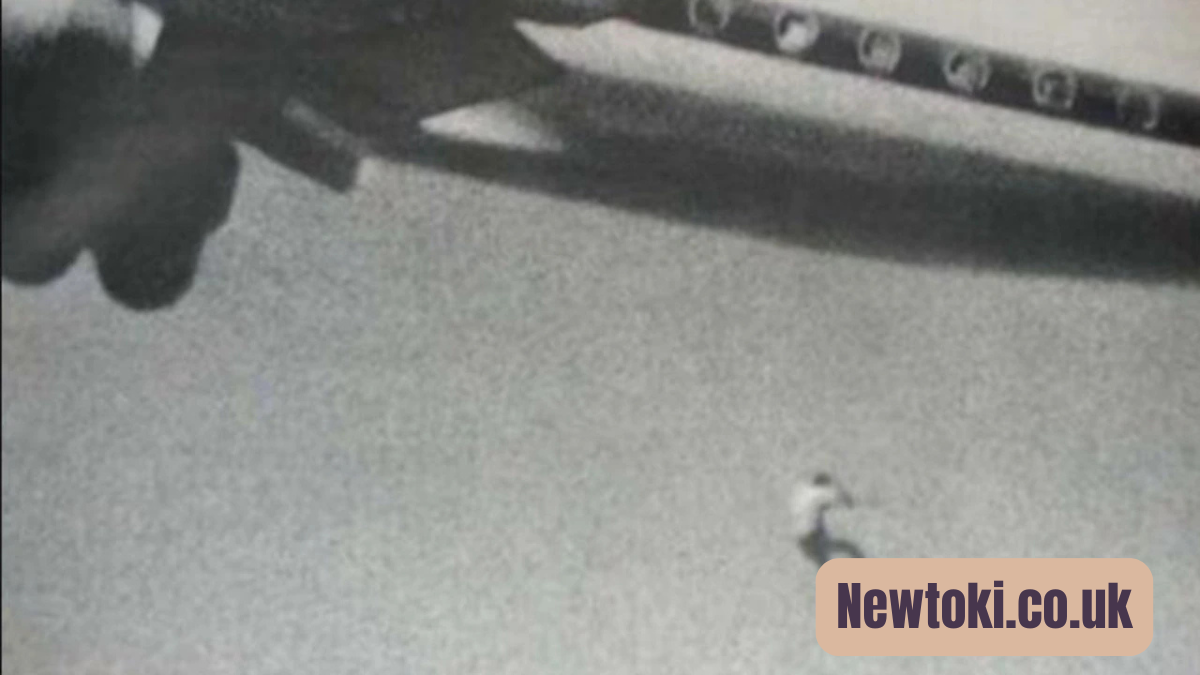
As the aircraft began its takeoff sequence, Keith reportedly fell from the wheel well shortly after the landing gear retracted. The moment was captured by an amateur photographer named John Gilpin, who happened to be testing his camera at the airport at the time. The photograph he took would later become one of the most widely circulated images associated with aviation tragedy.
The incident itself was over in moments, but its impact would last for decades. It highlighted vulnerabilities in airport security and became a reference point in discussions about stowaway risks and aviation safety improvements.
The Photograph That Defined the Story
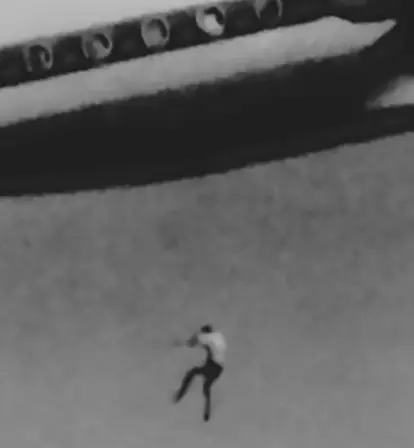
One of the most significant aspects of Keith Sapsford’s story is the photograph taken by John Gilpin. The image shows the aircraft ascending with a small figure falling from it. Although brief and distant, the photograph carries a powerful emotional weight that has made it widely discussed in media, aviation literature, and safety training contexts.
John Gilpin was not a professional news photographer at the time. He was working in industrial photography and happened to be at the airport for unrelated reasons. According to accounts, he was testing his camera equipment when he inadvertently captured the moment. He only realized the significance of the image after developing the film.
This photograph became one of those rare historical images that encapsulate an entire tragedy in a single frame. It is often used in discussions about the unpredictability of life, the consequences of impulsive actions, and the importance of safety awareness in aviation environments.
While the image is powerful, it is also handled with sensitivity due to the nature of the event it represents. It serves as both a historical record and a reminder of how quickly life can change in high-risk environments.
Psychological and Behavioral Aspects of the Incident
When examining Keith Sapsford’s actions, experts often discuss the psychological factors that may influence such behavior in young individuals. Adolescence is a period marked by curiosity, risk-taking tendencies, and an underdeveloped understanding of long-term consequences. These factors can sometimes combine in ways that lead to dangerous experimentation.
In Keith’s case, the idea of stowing away on an aircraft may have seemed like an adventurous shortcut to exploring the world. However, what may appear possible in imagination often differs drastically from reality. The risks associated with aircraft wheel wells, including lack of oxygen, extreme cold, and mechanical hazards, are not intuitive to someone without technical knowledge.
Behavioral analysis of similar historical cases suggests that such decisions are rarely based on a full understanding of danger. Instead, they are often driven by curiosity, peer influence, or a desire for escape. Keith’s story is frequently referenced in educational contexts as an example of why awareness and supervision are important during adolescence.
Aviation Safety Lessons Learned
The incident involving Keith Sapsford contributed indirectly to broader conversations about aviation security. While airport security improvements were already underway in many parts of the world during the 1970s, incidents like this reinforced the need for stricter perimeter control and aircraft monitoring.
Modern airports now employ multiple layers of security, including surveillance cameras, restricted access zones, motion detection systems, and continuous personnel monitoring. Aircraft are also inspected more thoroughly during ground operations to ensure no unauthorized access occurs.
Wheel well stowaway attempts, while still rare, have become significantly more difficult due to these advancements. The aviation industry treats such risks seriously, as survival rates for stowaways in landing gear compartments are extremely low due to environmental and mechanical factors.
Keith Sapsford’s case is often included in aviation safety discussions as a historical example of why layered security systems are essential. It highlights how even a single oversight can lead to irreversible outcomes.
Media Coverage and Public Reaction
When the incident became known, media outlets quickly picked up the story due to its unusual and tragic nature. The combination of a young individual, an international aircraft, and a dramatic photograph made it widely discussed in newspapers and later aviation publications.
Public reaction at the time was a mixture of shock and sadness. Many people struggled to understand how such an event could occur, especially involving a child. The photograph added a visual dimension that intensified emotional responses, making the story more impactful than written reports alone.
Over time, the story has been revisited in documentaries, aviation safety discussions, and online historical archives. While it is not widely known among the general public compared to major aviation disasters, it remains a significant case study within specialized fields.
The Legacy of Keith Sapsford
Keith Sapsford’s legacy is not one of achievement in the traditional sense, but rather a cautionary example that continues to be referenced in aviation safety education. His story is often used to illustrate the importance of understanding real-world risks and the consequences of impulsive decisions.
In photography circles, the image captured by John Gilpin is also studied as an example of unintended documentary photography—where a moment is captured without the photographer initially realizing its significance. This adds another layer to the legacy of the event.
Within aviation safety frameworks, the incident is part of historical records that helped shape modern security thinking. It is a reminder that safety protocols are often developed in response to past vulnerabilities, even when those vulnerabilities were rare or unexpected.
Ethical Reflections on the Story
Stories like Keith Sapsford’s also raise ethical considerations about how such events are documented and shared. The photograph, while historically important, represents a deeply tragic moment. This creates a balance between preserving historical truth and respecting human dignity.
Many educators and historians approach the topic carefully, focusing on the lessons learned rather than sensationalizing the event. The goal is to ensure that the story is used constructively, particularly in safety education and risk awareness.
It also highlights the responsibility of media and storytellers to handle sensitive subjects with care. While the image is impactful, it is most meaningful when contextualized properly rather than consumed without understanding.
Why the Story Still Matters Today
Even decades later, the story of Keith Sapsford remains relevant because it touches on universal themes: curiosity, risk, consequences, and safety. It serves as a reminder that environments like airports are highly controlled for a reason, and that even small lapses in judgment can lead to irreversible outcomes.
In a modern context, where aviation is significantly safer and more secure, the story still finds value as a teaching tool. It helps reinforce why regulations exist and why adherence to safety systems is critical.
Ultimately, Keith Sapsford’s story continues to resonate not because of its tragedy alone, but because of the lessons it leaves behind for future generations.
FAQs
Who was Keith Sapsford?
Keith Sapsford was a young Australian boy known for a tragic 1970 incident at Sydney Airport involving a stowaway attempt on an aircraft.
What happened to Keith Sapsford?
He attempted to hide in the landing gear compartment of an aircraft and fell during takeoff, resulting in a fatal accident.
Who took the famous photograph of the incident?
The photograph was taken by John Gilpin, an amateur photographer who unknowingly captured the moment while testing his camera.
Why is Keith Sapsford’s story still discussed today?
It is often referenced in aviation safety and education as a cautionary example of the dangers of stowing away on aircraft.
What lesson does Keith Sapsford’s story teach?
It highlights the importance of understanding real-world risks, especially in high-danger environments like airports and aircraft operations.
Also read: The Byford Dolphin Accident: A Detailed Look at One of Offshore Diving’s Most Tragic Failures