The Byford Dolphin Accident: A Detailed Look at One of Offshore Diving’s Most Tragic Failures
Introduction to the Byford Dolphin Accident
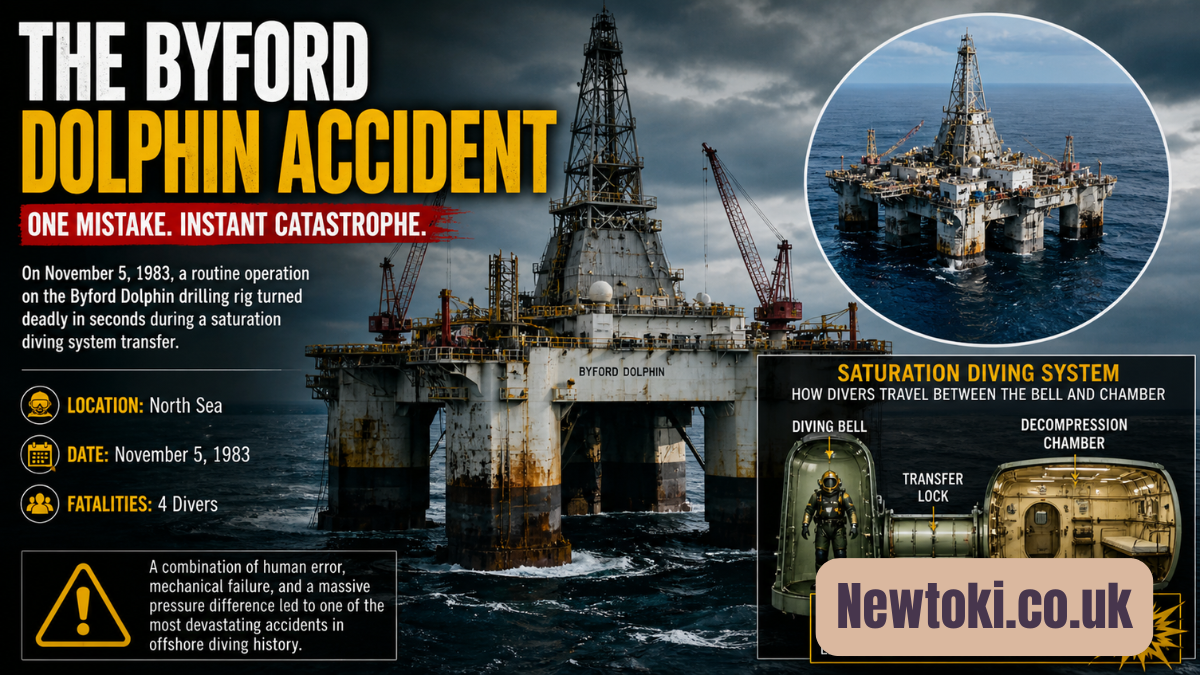
The Byford Dolphin accident is one of those events in offshore oil history that still gets talked about decades later, not because it happened often, but because of how extreme and sudden it was. It took place in 1983 on a semi-submersible drilling rig operating in the North Sea, an area known for harsh weather, deep waters, and highly technical offshore operations. The incident involved a saturation diving system, which is a highly specialized setup used by professional divers working at extreme depths for extended periods.
At its core, this accident is often discussed in diving safety training because it highlights what can go wrong when pressurized systems are mismanaged. Saturation diving is already a high-risk occupation, and the Byford Dolphin incident became a case study in understanding pressure systems, decompression procedures, and human error in engineering environments. Even today, it is referenced in discussions about offshore safety improvements and hyperbaric system design.
What makes this event particularly notable is not just the technical failure, but the way it exposed gaps in safety protocols at the time. Offshore drilling in the early 1980s was evolving rapidly, but some systems and procedures had not yet caught up with the scale of the risks involved. The Byford Dolphin accident became a turning point in how diving bell operations and decompression chambers were evaluated and regulated.
The Byford Dolphin Rig and Its Diving System
The Byford Dolphin was a semi-submersible drilling rig, meaning it was designed to float and operate in deep waters while maintaining stability through ballast systems. It was used primarily for offshore oil exploration and drilling operations in the North Sea, where conditions are notoriously rough. Because divers were required to work at significant depths, the rig was equipped with a saturation diving system to support long-duration underwater tasks.
A saturation diving system allows divers to live under pressure for days or even weeks at a time. Instead of repeatedly decompressing after each dive, divers remain in a pressurized environment and only decompress once at the end of their rotation. This system is efficient and reduces the risk of decompression sickness, but it requires extremely precise engineering and strict procedural control. The system onboard Byford Dolphin included living chambers, transfer locks, and a diving bell used to transport divers between the surface and underwater work sites.
The diving bell itself is essentially a pressurized elevator that connects the underwater environment with the surface system. Divers enter and exit through controlled pressure transitions, and the entire operation depends on synchronized valve systems and trained operators. In the case of the Byford Dolphin, this synchronization is exactly where things went catastrophically wrong.
Understanding Saturation Diving and Its Risks
Saturation diving is a method used to allow divers to work at extreme depths for extended periods without suffering repeated decompression stress. When a diver spends time under high pressure, their body tissues become saturated with inert gases like helium. Once saturation is reached, additional time at depth does not significantly increase decompression requirements, which is why divers can stay down for long rotations.
However, the process of returning to surface pressure is highly delicate. Divers must be brought back slowly through controlled decompression in specialized chambers to avoid fatal complications. Any sudden change in pressure can cause catastrophic physical effects on the human body. This is why every step in the system is designed with redundancy, safety checks, and strict communication protocols.
Despite these safeguards, saturation diving remains inherently risky. It relies on mechanical systems, human coordination, and precise timing all working perfectly under stressful offshore conditions. Even a small miscommunication or mechanical failure can lead to severe consequences. The Byford Dolphin accident became a stark reminder of how unforgiving pressure-based systems can be when even one link in the chain fails.
The Sequence of Events Leading to the Accident
On November 5, 1983, routine diving operations were underway on the Byford Dolphin rig. The operation involved transferring divers between the diving bell and the decompression chambers through a system of pressurized hatches. At the time, several divers were inside the system, and a transfer procedure was being conducted between chambers.
The critical moment occurred during a connection procedure between the diving bell and the decompression chamber system. A series of clamps and hatches were involved in sealing and equalizing pressure between compartments. Due to a procedural error combined with mechanical misalignment, a clamp was released prematurely while pressure levels were still unequal.
This caused an explosive decompression event. The pressure difference between the high-pressure chamber and the external environment caused air and gases to rush violently through the opening. The force of this sudden pressure change had immediate and devastating consequences for anyone in the direct path of the system.
It is important to understand that this was not an explosion in the traditional sense involving fire or fuel. Instead, it was a rapid and violent equalization of pressure that resulted in catastrophic mechanical and physiological effects. The system essentially failed to maintain controlled conditions, and the energy released by the pressure differential was immense.
The Physics Behind the Pressure Failure
To understand why the Byford Dolphin accident was so severe, it helps to look at the physics of pressure differentials. In saturation diving systems, internal pressure can be several times higher than atmospheric pressure at sea level. This pressure is carefully controlled to match underwater conditions and protect divers from decompression sickness.
When a barrier between high-pressure and low-pressure environments is suddenly removed, the gases inside rush outward with extreme force. This is governed by basic fluid dynamics, where pressure seeks equilibrium. The greater the difference in pressure, the more violent the equalization process becomes.
In the case of the Byford Dolphin, the pressure differential was large enough that the sudden release created forces beyond what human tissue and standard mechanical structures could withstand. This is why such systems require multiple interlocks and sequential safety mechanisms. When those fail or are bypassed, the results can be immediate and irreversible.
The physics involved also explain why saturation diving systems are designed with redundancy. Even a single premature opening of a valve or hatch can disrupt the entire pressure balance. The Byford Dolphin incident became a textbook example of how not just equipment failure, but procedural timing errors can lead to catastrophic outcomes in high-pressure environments.
Human and Operational Factors
While mechanical failure played a role, human factors are also a critical part of understanding what happened on the Byford Dolphin. Offshore operations require strict coordination between operators, divers, and supervisors. Communication is typically done through standardized protocols to avoid ambiguity in high-stakes environments.
In this case, a sequence of operational decisions contributed to the accident. Miscommunication between crew members and improper confirmation of pressure equalization procedures were key factors. In complex systems like saturation diving setups, every step must be explicitly verified before moving to the next stage.
Fatigue, environmental stress, and the demanding nature of offshore work can also influence decision-making. Workers on rigs often operate in rotating shifts, and the environment itself can be physically and mentally exhausting. While no single individual is solely responsible, the combination of human error and system design flaws created a scenario where a mistake had no buffer for recovery.
This is one of the most important lessons from the Byford Dolphin accident: in high-risk industries, systems must be designed to prevent single-point failures from becoming catastrophic events.
Investigation and Findings After the Incident
After the accident, a detailed investigation was conducted to determine what went wrong and how similar incidents could be prevented in the future. Investigators examined the mechanical systems, operational procedures, and training protocols in place at the time. The focus was not just on identifying faults, but also on understanding systemic weaknesses.
One of the key findings was that the locking and pressure equalization system did not have sufficient safeguards to prevent premature release under certain conditions. Additionally, procedural checks were found to be vulnerable to human error, especially under time pressure or miscommunication.
The investigation also highlighted the importance of interlock systems that physically prevent unsafe operations until all conditions are correctly met. In modern systems, these interlocks are far more advanced and often automated to reduce reliance on manual confirmation.
The conclusions drawn from the investigation led to significant changes in offshore diving safety standards. Equipment design, operational protocols, and training requirements were all reviewed and updated to prevent similar incidents in the future.
Impact on Offshore Safety Regulations

The Byford Dolphin accident had a lasting impact on offshore safety regulations, particularly in the field of saturation diving. One of the most important outcomes was the introduction of stricter interlock requirements for pressure systems. These ensure that certain actions cannot be taken unless all safety conditions are verified and met.
Training protocols for diving supervisors and operators were also significantly improved. Emphasis was placed on communication clarity, procedural discipline, and redundancy in safety checks. In addition, equipment manufacturers began redesigning diving systems with improved fail-safe mechanisms.
Regulatory bodies in the offshore industry used the incident as a case study for improving international safety standards. Over time, this contributed to a broader culture shift in offshore operations, where safety became more tightly integrated into engineering design rather than treated as an operational afterthought.
Today, many of the safety systems used in saturation diving can trace their improvements back to lessons learned from this incident. While offshore work still carries risks, the probability of similar failures has been greatly reduced due to these changes.
Myths and Misconceptions About the Incident
Over the years, the Byford Dolphin accident has been surrounded by various myths and exaggerated claims. One common misconception is that it involved a traditional explosion or fire, which is not accurate. The event was caused by rapid decompression, not combustion or external blast forces.
Another misconception is that it was solely due to a single mechanical failure. In reality, investigations showed that it was a combination of procedural error, system design limitations, and human factors. Assigning blame to a single point oversimplifies a complex chain of events.
There are also exaggerated descriptions circulating online that focus on graphic details rather than technical understanding. While the event was undoubtedly tragic, its importance lies more in the engineering and safety lessons it provided rather than sensationalized narratives.
Understanding what actually happened helps separate fact from fiction and ensures that the focus remains on improving safety rather than amplifying misinformation.
Lessons Learned From the Byford Dolphin Accident
One of the most important lessons from the Byford Dolphin accident is the critical importance of system redundancy. In high-risk environments, no single action or component should be capable of causing catastrophic failure without multiple layers of protection.
Another key lesson is the importance of human-system interaction design. Even highly trained professionals can make mistakes, especially under pressure or in complex environments. Systems must therefore be designed to anticipate human error and prevent it from escalating into disaster.
The accident also reinforced the need for continuous improvement in offshore safety standards. Technology evolves, and safety protocols must evolve with it. What was considered acceptable in the early 1980s is no longer sufficient for modern offshore operations.
Ultimately, the incident serves as a reminder that engineering safety is not just about machines, but about understanding how people, procedures, and systems interact under extreme conditions.
Conclusion
The Byford Dolphin accident remains one of the most studied incidents in offshore engineering history. While it was a tragic event, it also became a catalyst for major improvements in diving safety, pressure system design, and operational protocols. The lessons learned continue to influence modern offshore practices, ensuring that similar failures are far less likely to occur today.
It stands as a powerful example of how complex systems require constant vigilance, precise coordination, and respect for the forces involved. In industries where pressure, depth, and human life intersect, even small errors can have irreversible consequences, making safety engineering not just important, but essential.
FAQs
What was the Byford Dolphin accident?
It was a fatal decompression incident in 1983 involving a saturation diving system on an offshore drilling rig in the North Sea.
What caused the Byford Dolphin accident?
It was caused by a combination of procedural error, mechanical failure, and premature pressure release during a diving system operation.
Was it an explosion?
No, it was a rapid and uncontrolled decompression event, not a chemical or fire-based explosion.
Why is the incident still studied today?
Because it highlights critical lessons in pressure system safety, human error, and offshore engineering design.
Did it change safety regulations?
Yes, it led to significant improvements in diving system design, interlock safety mechanisms, and operational procedures.
Also read: Kellie Chauvin: Life Story, Background, Public Attention, and Life After Controversy